Gap Got It Right — But Here's What Brands Usually Get Wrong
A creative strategy lens on the Gap x Young Miko campaign, the Puerto Rican cultural moment, and the line between celebration and extraction.
There's a campaign running right now that's worth eyeing — not just because it's good, but because it's rare. Gap's Spring 2026 “Sweats Like This" campaign starring Young Miko is being celebrated across marketing circles for its cultural resonance. And the praise is deserved. But as someone who sits at the intersection of design, brand strategy, and Caribbean multicultural identity, I want to go deeper than the applause. I want to name exactly why it works — because understanding why it works is how we hold other brands accountable when they don't.
What Gap Actually Did
Young Miko described the experience simply: "Working with Gap felt natural because they gave me the space to express myself and my culture authentically." (WWD) That one sentence is the entire brief. The space to be authentic. Not molded, not translated, not softened for a general audience.
And what Gap understood is that Young Miko's authenticity isn't just musical — it's visual. She moves between art and music as a single creative practice, building a world that is distinctly hers. The campaign didn't borrow her audience. It borrowed her entire creative universe — and gave it space to breathe.
And this isn't the first time Gap has chosen not to soften. Earlier this year, when American Eagle launched a campaign starring Sydney Sweeney built around the tagline “great genes" — a phrase that drew immediate and justified criticism for its eugenic undertones — Gap didn't respond with a statement. They responded with a clapback campaign. One that deliberately celebrated bodies, colors, and cultures in their plurality. The message was quiet but unmistakable: no single gene is superior.
Two campaigns. The same underlying conviction. Gap isn't just casting diversely — they're building a brand position around the idea that culture doesn't need to be diluted to sell clothes. That's a strategic choice, not a coincidence. And in 2025, when Latino and minority consumers are spending with increasing intention toward brands that see them, it's also a smart business decision.
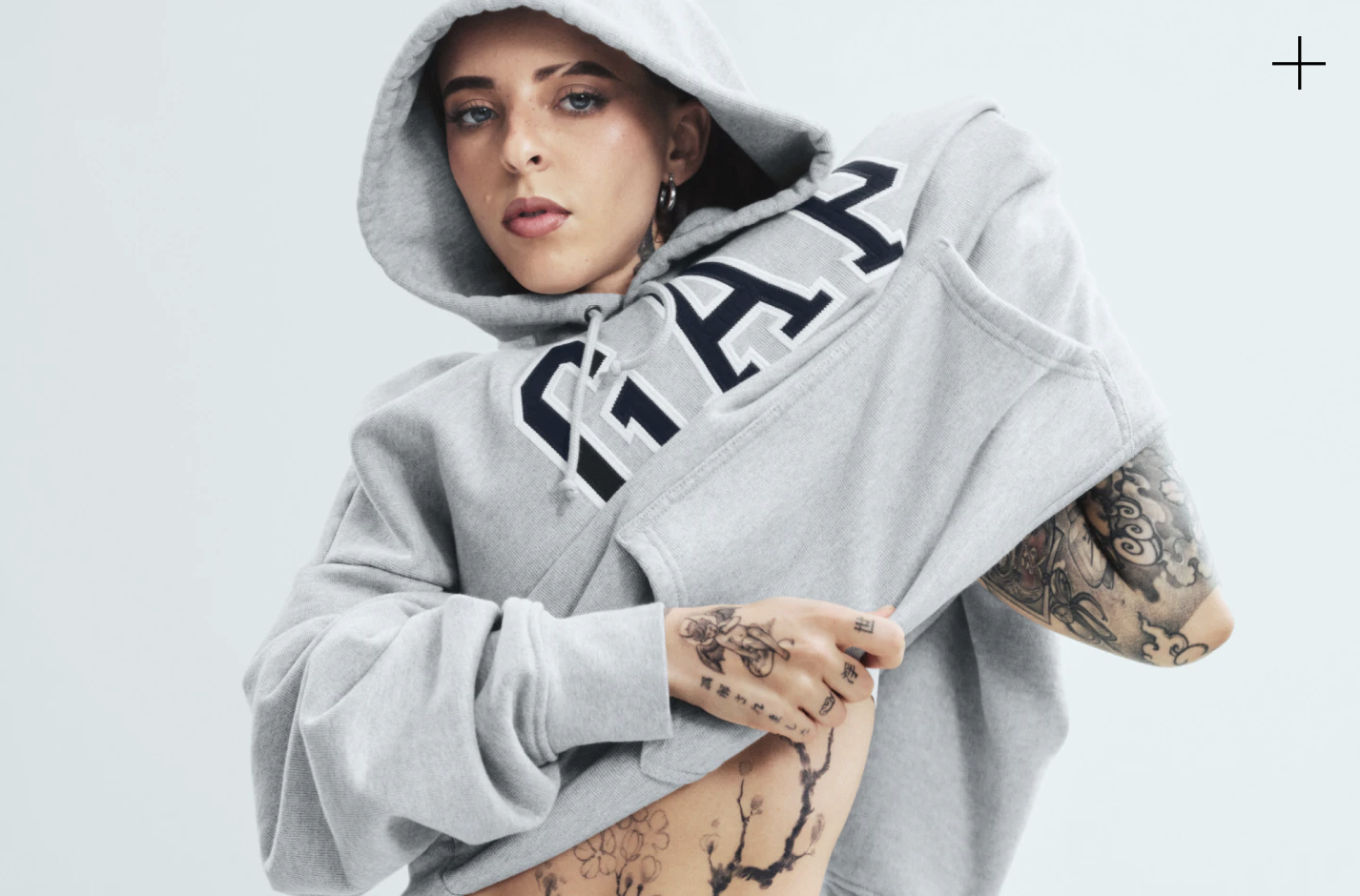
Image via Gap / "Sweats Like This" Campaign
The question worth asking is: what took so long — and who else is paying attention?
The structural proof is in the details. This marks the first time in Gap's 56-year history that it ran a campaign entirely in Spanish — a point of pride for Latina CMO Fabiola Torres. (Campaign Live) The campaign video was directed by Mexican American filmmaker Bethany Vargas, shot by Olivia Malone, and choreographed by Zoi Tatopoulos — an all-women creative team bringing Young Miko's vision to life. (EDGE Media Network) The cast featured 26 predominantly Latin dancers moving freely in GapSweats. (WWD)
The product is secondary. Her world is primary. That's the inversion that most brands still can't bring themselves to make when celebrating cultura.
Why This Moment Is Bigger Than One Campaign
This didn't happen in a vacuum. The campaign arrives in sync with Bad Bunny's historic Super Bowl halftime show — both artists hailing from Puerto Rico, both delivering a message about inclusivity and cultural celebration at a moment when that message carries particular weight. (Muse by Clios)
We are in a transitional season. Minority and Latino consumers — long treated as secondary markets — are asserting buying power with intention. The message to brands is no longer subtle: speak to us genuinely or lose us entirely. Gap read the room. More importantly, they acted on it structurally, not just aesthetically.
The Fine Line — And Why It Matters
Here's where I want to slow down, because celebration and extraction can look nearly identical from the outside.
Gap's approach works because Young Miko's culture wasn't the product — it was the context. The sweats were the product. Her world gave them meaning. That's a crucial distinction.
Extraction looks different. It looks like a brand taking the aesthetic of a culture — the visual language, the sounds, the symbols — stripping the context, and reselling it to a broad audience as a trend. The culture becomes a commodity. The people who built and carried it become consumers of their own heritage. We've seen it happen countless times — not just to products, but to food.
We have a clear pattern to study. Matcha traveled from centuries of Japanese tea ceremony into a $7 airport latte — the aesthetic crossed over, the meaning largely didn't, and the communities who held it sacred rarely saw the financial benefit. Mezcal, rooted in Oaxacan Indigenous craft, became a premium “artisanal" spirit sold in Brooklyn bars at markup prices that didn't flow back to the producers.
Now ask yourself: is Coquito next?
The drink already has every ingredient the mainstream market loves — it's creamy, seasonal, photogenic, tied to a culture having a major mainstream moment. We've already seen it begin. When Wendy's Puerto Rico launched a Coquito Frosty across all 85 locations on the island (eyboricua.com), many Puerto Ricans celebrated it as a cultural moment. And here's where it gets complicated — because the Wendy's Puerto Rico franchise is actually owned by Grupo Colón Gerena, a Puerto Rican family business founded in 1979, sourcing local milk, local beef, local eggs. When it went viral, mainland U.S. fans immediately started petitioning for it to go nationwide (Change.org) — and that's the moment the trajectory becomes clear.
But the question isn't only about who owns the franchise. It's about what happens when a beloved cultural tradition gets filtered through a fast food format and sold at scale. When coquito moves from your grandmother's kitchen to a drive-through window, something shifts — even if the hands making it are Puerto Rican. And if it gains enough mainstream visibility, the next stop is a $7 seasonal latte at Starbucks. Not a prediction. A pattern. Because it's the exact arc matcha traveled. The exact arc mezcal traveled. That's the conversation worth having — what scale does to culture, regardless of intent.
The Creative Strategy Lesson
From a brand strategy standpoint, Gap's campaign offers a replicable framework — but only if brands are willing to follow it honestly, and cautiously enough not to hurt the very cultures they celebrate:
Let the artist lead creatively, not just perform. Young Miko was a true creative collaborator — she helped shape the campaign as a visual extension of her music, not a Gap visual with her face on it. (Gap Inc.)
Build the infrastructure to match the intention. Gap didn't just cast a Latina — they hired a Latina director, a Latina CMO is steering the brand vision, and the campaign was performed entirely in Spanish. The commitment went beyond the talent.
Let the product be secondary to the world.The Gap sweats are shown through movement, ease, and self-expression — through her movement. Not posed. Not forced. The clothes become believable because her world is believable.
This is the standard. And it's a high one. Most brands casting diverse talent are still doing step zero — the casting — without doing steps one through three.
What We Should Be Watching For
As Puerto Rican culture continues its mainstream moment, the creative and brand strategy community — especially those of us with roots in these cultures — has a responsibility to name what we see.
Celebration looks like Young Miko leading her own campaign, in Spanish, surrounded by her community, with her music at the center.
Extraction looks like a cultural tradition leaving the hands of the people who built it — and returning to them as a product they have to buy back.
The difference isn't always obvious. That's why it needs to be named — clearly, specifically, and without apology.
This is the first entry in an ongoing series examining how Latino and Caribbean culture moves through brand, design, and creative strategy — who profits when it does, and how we can encourage our communities to step into these spaces owning and authoring their own heritage.